

Photovoltaic optimisers: what they are and why they are important
How to maximise the energy production of each module and increase savings in your bill.
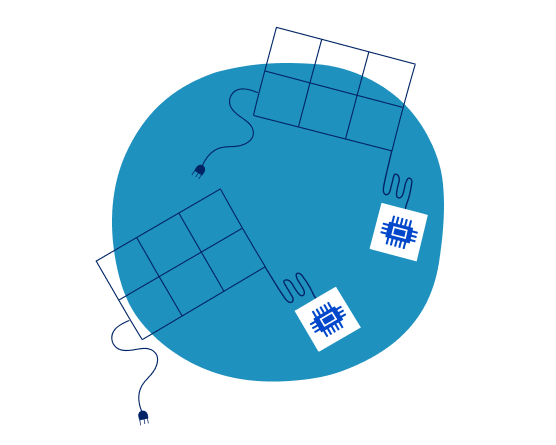
A solar system is an investment designed to produce energy for decades, but its actual yield depends on how much each individual component is able to work at its maximum potential.
In this scenario, photovoltaic optimisers allow each module to be managed independently, preventing localised shading or dirt accumulation from reducing the overall production of the system.
What photovoltaic optimisers are and how they work
Photovoltaic optimisers are electronic devices installed on each individual photovoltaic module to maximise its individual yield. Their function is to make each panel independent from the rest of the string, ensuring that it constantly works at its own maximum power point (MPPT). In a traditional system, the panels are connected in series: if one produces less due to shading or dirt, the entire string adapts to the performance of the weakest module.
Optimisers eliminate this bottleneck effect, allowing each panel to give its maximum and thus preserving the overall performance of the system and savings in the bill.
When are photovoltaic optimisers really needed?
The technology brings benefits to any system, but becomes particularly relevant in some specific conditions:
Partial shading: chimneys, antennas or trees that cast shadows even for just a few hours a day on a portion of the roof can significantly penalise production. The optimiser limits the impact to the single panel involved.
Roofs with multiple exposures: if the modules are installed on pitches oriented differently, such as east and west, the optimisers manage the different levels of irradiation independently, without conflicts between strings.
Granular monitoring: for those who want precise visibility on the production of each individual panel, these devices offer real-time control via app, making it easier to identify anomalies or drops in performance.
Environments with frequent deposits: in areas with smog, organic dust or saltiness, where deposits quickly accumulate on the modules, the optimiser mitigates efficiency losses in the interval between one maintenance operation and another.
How many optimisers are needed and how much do they cost?
The general rule provides for one device for each installed panel. There are also “dual” solutions capable of managing two modules at the same time, which can optimise costs in larger systems.
On the economic front, the cost varies based on the number of modules, the type chosen and the extent of the installation intervention. For a standard 3 kW residential system (approximately 8–10 modules), the overall investment is indicatively around €700 to €1,200, including devices and installation. However, it is possible to access more advantageous integrated solutions: for example, by opting for complete packages such as Enel’s Black Edition offer, it is possible to include these technologies in a single turnkey solution with refined design and high performance.
Cost recovery depends on the extent of shading and the incremental production obtained: in favourable contexts, the payback is generally placed over a period of a few years. For an accurate estimate related to your own system, it is advisable to request a technical inspection.
The benefits for your system
The primary benefit is, of course, the increase in total annual production, which can vary from 5% up to 25% in cases of strong shading. This translates directly into an improvement in the performance of photovoltaic panels and faster amortisation of the investment.
On the safety front, the optimisers communicate with the inverter to reduce the direct current voltage of the modules to safe levels in the event of a fault or emergency intervention, facilitating maintenance and rapid shutdown operations.
Optimisers eliminate this bottleneck effect, allowing each panel to give its maximum and thus preserving the overall performance of the system and savings in the bill.
Frequently asked questions
Can I install optimisers on an already existing photovoltaic system?
Yes, it is possible through a retrofit intervention, but it is strongly recommended to provide for them during the initial purchase phase.
Adding them later, in fact, requires the disassembly and reassembly of each individual module, thus increasing labour costs. Integrating them immediately allows you to minimise the installation expense and maximise saving. In the event of retrofit, it still remains essential to verify technical compatibility with the existing inverter to ensure that the components can communicate correctly and monitor production data.
What happens if an optimiser stops working?
The monitoring system promptly reports the anomaly via app. The advantage compared to traditional systems is that only the panel associated with that device will reduce its performance, while the rest of the system will continue to produce normally.
Do optimisers eliminate the need for maintenance?
No. They improve electronic yield and mitigate losses due to deposits, but they do not replace module care. Ordinary maintenance and wiring checks remain essential to guarantee the longevity of the system.
Are there overheating risks for these devices?
Quality optimisers are designed to withstand high temperatures and weather conditions. It is still good practice to monitor that excessive deposits, such as dust or droppings, do not accumulate, as they could create localised overheating and penalise the device’s efficiency.
You may also be interested in ...

Verify ZIP Code
Enter the ZIP code of the residence for which you want to activate the offer and check if you're eligible. If the result is positive, you can proceed with the subscription.

Ci dispiace! Sembra che il tuo CAP non rientri tra quelli in cui è possibile sottoscrivere l’offerta
Find out what type of Fiber is available at your address
With Enel Energia Fiber, you always surf at the highest speed available. Enter your address and discover the details of your new connection.
Ci dispiace! L’indirizzo che hai inserito non è ancora raggiunto dalla fibra di Enel Energia
In questo momento non è possibile attivare l’offerta sull’indirizzo indicato perché non è raggiunto dalla fibra di Enel Energia. Puoi sempre verificare un altro indirizzo.
Qualcosa è andato storto
Riprova più tardi
Discounted offer
By purchasing the air conditioner, you’ve unlocked an exclusive discount code and are entitled to a reward. Enter the code to receive a €360 bill bonus with the Formidabile Luce offer tailored for you.

The offer includes a Power contract with a €10 monthly bill bonus for 36 months and an air conditioner starting from €19.90 per month. APR 7.48% and Annual Percentage Rate of Charge 7.74%.
Power

Formidabile Luce for you
The Formidabile Luce offer includes a discount on the list price of the energy component for customers switching from the Servizio di Maggior Tutela.

Locked for the first 12 months
Commercialization and Sales Fee
12 €/kWh
Air Conditioner at a Formidable Price
Purchase an Enel X air conditioning system with delivery, standard installation, and ENEA paperwork support included.*
Price air conditioner
, month

Standard installation included
ENEA paperwork support included*