Let’s simplify your choices, together
Do you have questions or would you like to learn more about what you have just read? One of our consultants is available to clarify any doubts and will help you find the ideal product for your needs.


When the Power bill arrives, terms such as kW and kWh often appear, but it is not always clear what they really mean. Understanding them, however, can make the difference: not only for reading consumption, but also for avoiding waste and choosing the most suitable offer.
The kilowatt (kW) is the unit of measurement for electrical power: it indicates the rate at which a device consumes Energy at a given moment. In other words, it expresses the speed at which Energy is consumed.
The kilowatt-hour (kWh), on the other hand, is the unit of measurement for electricity consumed over time. It represents the amount of Energy used by a device with a power of 1 kW for one full hour: kWh = kW × hours of use.
Example: a 2 kW washing machine running for one hour consumes 2 kWh. The same washing machine used for 30 minutes consumes 1 kWh.
| kW (kilowatt) | kWh (kilowatt-hour) | |
|---|---|---|
|
What it measures |
Power, how much Energy a device uses at a given moment |
Energy, how much Energy is consumed over time |
|
Unit of time |
Does not depend on time |
Depends on the hours of use |
|
Where it appears |
In the contract, committed power |
On the bill, billed consumption |
|
Example |
2 kW washing machine |
Washing machine used for 2 hours = 4 kWh consumed |
The two units have distinct roles in contract documents and on the Power bill.
The kW appears in the supply contract as committed power: the power level agreed with the supplier, usually 3 kW for a standard domestic user. The available power is the maximum value that can actually be supplied and is equal to the committed power increased by 10%: with 3 kW committed, the actual limit is 3.3 kW. If this value is exceeded for more than 180 consecutive seconds, the meter temporarily interrupts the supply: this is the so-called disconnection or “meter trip”.
The kWh, on the other hand, is the unit used to measure and bill actual consumption. Every month, the meter records how many kWh have been withdrawn from the grid, and the Energy price is applied to that quantity.
In summary, the kW indicates how much is absorbed at a given moment, while the kWh indicates how much you consume over time.
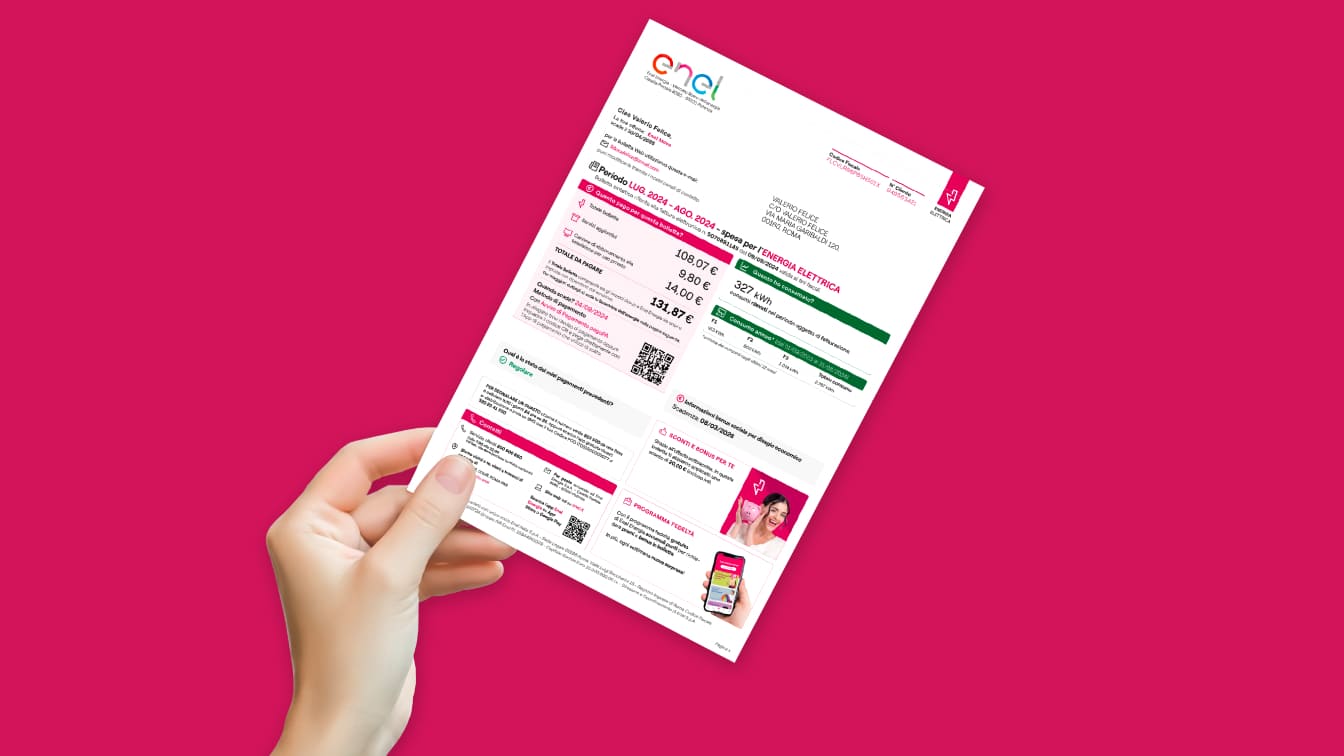
To learn how to correctly interpret the items on the bill, it is useful to consult the guide on how to read the Power bill and, if you also have a gas supply, the guide on how to read the gas bill.
Applying the formula kWh = kW × hours to a few common household appliances immediately makes the difference between the two units clear. The following values are indicative and vary depending on the model, Energy class and usage methods.
| Household appliance | Power (kW) | Average daily use | kWh/day |
|---|---|---|---|
|
Washing machine |
~2 kW |
1 cycle (~1 h) |
0,5–2 kWh |
|
Electric oven |
~2,2 kW |
1 hour |
1–1,5 kWh |
|
Refrigerator |
~0,1–0,15 kW |
24 hours (in cycles) |
0,5–1,5 kWh |
|
TV (50'') |
~0,1–0,2 kW |
4 hours |
0,4–0,6 kWh |
|
Air conditioner (inverter) |
~0,7–1 kW |
4 hours |
1–2 kWh |
The table shows that power alone does not determine the cost on the bill: the refrigerator has low power, but since it is always on, it accumulates significant consumption over time. A modern air conditioner with inverter technology progressively reduces its absorption once the desired temperature has been reached, with actual consumption much lower than less efficient models.
The choice between a fixed or variable price rate also depends on these considerations: those with predictable consumption may prefer the stability of a fixed price; those whose usage varies greatly may evaluate the flexibility of a variable price.
Having a clear understanding of your consumption in kWh is the starting point for choosing an adequate Power offer. Knowing your annual consumption in kWh allows you to compare the offers available on the market and identify the most economically convenient one based on your habits. A home with few occupants and reduced consumption has different needs compared to a large family with several high-absorption household appliances.
Knowing your committed power in kW is equally important: if several devices are often used at the same time at home, it may be appropriate to evaluate a higher contractual power to avoid frequent disconnections.
Enel Power offers are designed to respond to different needs, with flexible solutions that take into account both contractual power and the kWh actually consumed.

The kW measures power, meaning how much Energy a device requires at a given moment. The kWh, on the other hand, measures Energy consumed over time and is the unit used to calculate costs on the bill. The kW is like the speed of a car, how fast you are going. The kWh is the distance travelled, how far you go over time.
Simply multiply the power of the household appliance, in kW, by the hours of use. Example: a 2.2 kW oven, maximum nominal power, used for 1 hour consumes on average around 1–1.5 kWh, because the oven cycles the heating element once the set temperature has been reached.
It is the value in kW agreed with the supplier when signing the contract. For domestic users, it is usually 3 kW. The actual available power is 10% higher, therefore 3.3 kW. Exceeding it for more than 180 consecutive seconds causes a temporary interruption of the power supply, the so-called disconnection or “meter trip”.
The kW appears in the section relating to committed power and available power. The kWh, on the other hand, is the unit used to indicate and bill actual consumption in the reference period.
Knowing your annual consumption in kWh allows you to compare the offers available on the market and choose the most convenient one based on your usage habits.
Not necessarily. A high-power appliance used for a few minutes can consume fewer kWh than a low-power appliance left on for many hours. Consumption in kWh always depends on the combination of power and usage time.
Enter the ZIP code of the residence for which you want to activate the offer and check if you're eligible. If the result is positive, you can proceed with the subscription.

With Enel Energia Fiber, you always surf at the highest speed available. Enter your address and discover the details of your new connection.
In questo momento non è possibile attivare l’offerta sull’indirizzo indicato perché non è raggiunto dalla fibra di Enel Energia. Puoi sempre verificare un altro indirizzo.
Riprova più tardi
By purchasing the air conditioner, you’ve unlocked an exclusive discount code and are entitled to a reward. Enter the code to receive a €360 bill bonus with the Formidabile Luce offer tailored for you.

The Formidabile Luce offer includes a discount on the list price of the energy component for customers switching from the Servizio di Maggior Tutela.
Locked for the first 12 months
Commercialization and Sales Fee
12 €/kWh
Purchase an Enel X air conditioning system with delivery, standard installation, and ENEA paperwork support included.*
Price air conditioner
, month

Standard installation included
ENEA paperwork support included*
The Formidabile Luce offer includes a discount on the list price of the energy component for customers switching from the Servizio di Maggior Tutela.
Locked for the first 12 months
Commercialization and Sales Fee
12 €/kWh